



Going on a Trip in Our Favorite Rocket Ship: Class Trips at Stuy
Stuyvesant teachers and students reflect on meaningful school trips
Reading Time: 6 minutes
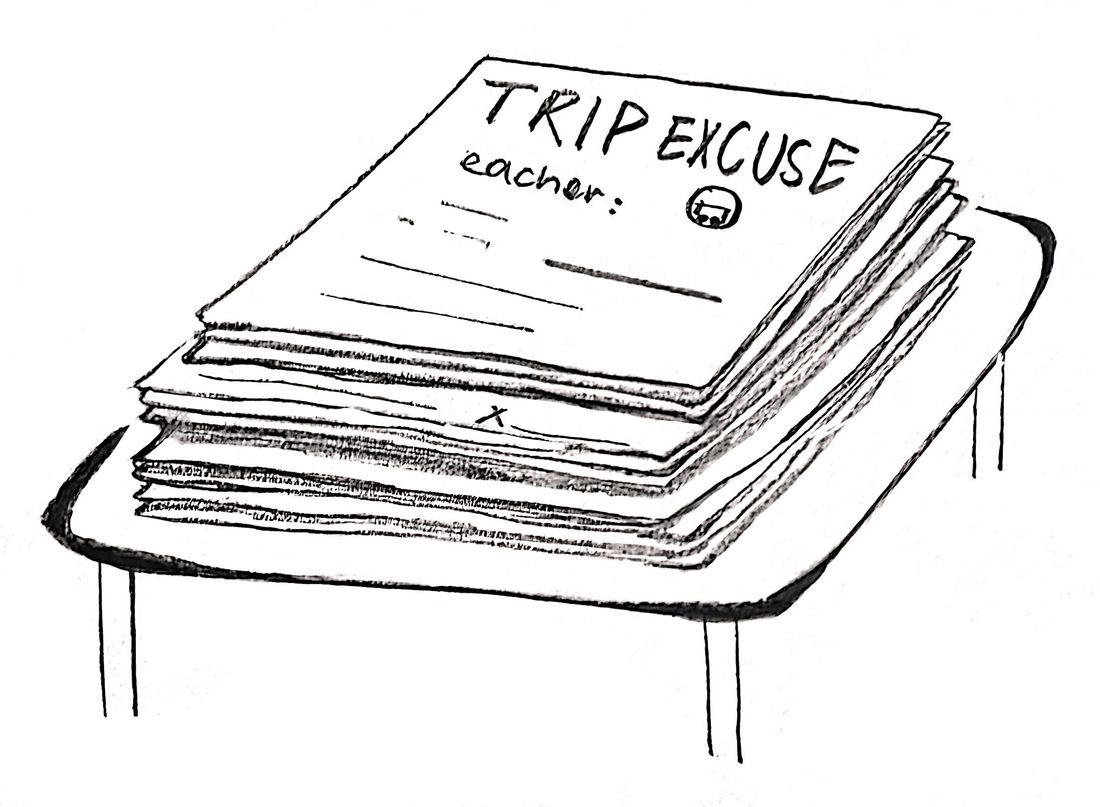
For many students, school trips were a defining feature of elementary and middle school, providing a chance to leave the classroom behind for the day and explore new frontiers. However, this delight seems to fade in Stuyvesant; some students never have the opportunity to go on a trip for their entire four years. Despite the overarching lack of school trips, many teachers still take the initiative to plan educational trips themselves to various places across the city, creating unforgettable memories while allowing students to apply their knowledge outside the classroom.
As a way of engaging students, some teachers seize any chance they have to offer trips that connect back to their lessons. For example, history teacher David Hanna recently led his History of the Middle Ages class on an annual trip to the Cloisters and the Cathedral of St. John the Divine during a unit about medieval churches. The chance to see the sights discussed in class in person reinforced the students’ understanding of his lectures. “When you get to actually see, for instance, the cathedral, there’s no comparison [to] anything you can read about, or even watch in a documentary, especially space, height, and light,” Hanna explained. “They have these really large stained glass windows, and it’s literally illuminating. And you can see it on [the students’] faces. That was what the intention was way back when I came up with the idea in the first place, but I can’t do that in the classroom.” Being able to walk in the very structures they wrote about in their notes served as a breathtaking experience unlike any other for students.
Similarly, Organic Chemistry students recently had the opportunity to listen to a lecture on conformational analysis at Columbia University on November 5. This trip was chaperoned by other science teachers, including Chemistry teacher Kristyn Pluchino, Chemistry teacher Jee Paik, and Physics teacher Thomas Miner. “The experience was really kind of eye-opening. You kind of connected everything you learned in chemistry all at once,” senior Maximiliano Pettica said. “Of course, there were some concepts that I didn’t understand because we weren’t really there yet in organic chemistry, but [for] other concepts, it just kind of made sense. For example, molecular orbital theory that we learned in general chemistry [but] never used [...] was integrated in how bonds were actually made and how molecules reacted.” Though not perfect, learning outside of the classroom provides an opportunity for students to deepen their understanding of concepts from class.
Teachers also appreciate school trips as an opportunity to enrich their own teaching and ensure that their students receive the best learning experience possible. “I wanted my students to see what a real college class is like. And I try to also just see what’s being taught at the college to make sure I’m still doing the class a good service,” AP Chemistry and Organic Chemistry teacher Dr. Steven O’Malley admitted. School trips ensure that teachers stay up-to-date with their teaching, enhancing student experiences in the classroom.
In addition to enhancing students’ learning experiences, trips are an opportunity for students to explore and form new friendships. “After the tours, I let [the students] just walk around the Cloisters by themselves. [...] Some people are in groups and, you know, they’re laughing, and they’re having fun, but other people are by themselves, and looking at different plants or flowers or just the view, and that’s kind of the idea,” Hanna explained. The freedom that students have to experiment with their own free time is a major advantage that school trips have over regular in-class lessons. In fact, Hanna noted that trips were such a key part of his elective course, they were likely the reason his proposal for the class was accepted. “I don’t know if they would’ve approved the course if I hadn’t put [the trips] in, to be honest,” Hanna added.
The liberty to explore learning was mirrored in the Organic Chemistry trip. “Dr. O’Malley allowed us to go wild for at least five minutes; we went over to the Hamilton building and took pictures with the statue of Alexander Hamilton,” Pettica described. “It was a really fun experience to talk to others and get that academic vibe of an Ivy League. It was kind of like a college tour mixed with a real class.” Trips allow students to socialize with each other, create exciting memories, and may even offer new insights. “That trip made me want to consider Columbia,” Pettica added.
On a trip to the DNA Learning Center in Brooklyn, students in Genetics were also able to participate in hands-on activities that made the trip all the more engaging. “We had to test the inside of our mouth, the cheek cells, to see if we had a certain jumping gene, and we did gel electrophoresis,” senior Remi Barua recalled. School trips can give students the chance to engage in techniques and activities they otherwise wouldn’t be able to experience in a classroom.
While many trips are mainly academic, there are also opportunities for students to appreciate the performing arts, specifically Broadway. On a trip to see the Broadway play Harry Potter and the Cursed Child, organized by Julie Sheinman for her Foundations of Literature class, students were excited for an experience that usually costs hundreds. “I vividly recall the jaw-dropping illusions, and the set changes were incredible too. Everything about the production exceeded my expectations, and our seats were awesome, so we got an even more immersive experience,” senior Amy Deng recalled. Trips offer students exciting opportunities they may not have access to outside of school, allowing them to appreciate the city’s offerings.
Considering the benefits of school trips for students and teachers alike, it’s a given that an immense amount of planning is required beforehand to ensure everything runs smoothly. “Anytime a teacher wants to take students on a field trip, there are logistics that have to be taken care of ahead of time. You gather your permission slip forms. You have to make sure you get the signatures on those from all the students. I had to solicit a few coworkers to agree to chaperone with me. Luckily, the principal and the principal’s secretary were very [helpful] in getting me the forms and helping me figure out the stuff I needed to do,” Dr. O’Malley explained.
Despite the value that these trips offer, accessibility still remains an issue. Due to constraints and the volume of students, most school trips operate on a first-come, first-served basis. As a result, teachers often feel they have limited opportunities to offer trips. “Any time I have a singleton—that means only one section of a course—I always go on a trip. The last two years, I only had one section of AP U.S. [History], so we went to Grant’s tomb and all these different places, the Brooklyn Bridge, and historical locales in the city. It’s wonderful, but it’s because I had one. Now, I have 268 students; it’s too many,” Hanna said. As teachers often teach multiple sections for a course, it is hard to plan trips that remain safe and organized.
Even teachers with smaller class sizes face a similar issue. Dr. O’Malley’s Organic Chemistry class has 68 students, but there were still students unable to make the trip. “There were a few students who weren’t able to go because they didn’t get their paperwork in time, and I didn’t have space, and I feel disappointed about that. And they feel disappointed too,” Dr. O’Malley lamented.
Students often look forward to and enjoy being on field trips, engaging with new opportunities to explore, deepen their understanding of class material, and form closer ties with their classmates. However, there are many factors, from large class sizes to students failing to fill out their trip forms, that limit such opportunities. Still, teachers and students seize and appreciate every trip available to them. As Dr. O’Malley concludes, “Anytime you can take advantage of something to get us out of school and have it be educational [and] meaningful, let’s do it.”